How to Ship Car Parts Safely in Australia
Couriers, road freight, palletised engines, dangerous goods and freight insurance — how to ship and receive used car parts without losing money.
Why freight makes or breaks a used-parts deal
A used part bought across town for cash is simple. The same part bought from a wrecker 1,800 km away is a freight problem first and a part problem second. Freight on used car parts can easily run from $25 for a small box courier to $400+ for a palletised engine on a transport pallet, and getting the freight wrong is one of the most common ways a good deal turns into a bad one.
Before you commit to any interstate part, get a freight quote. Before you ship a part you've sold, weigh and measure it accurately. Most freight disputes come from one side or the other guessing instead of measuring.
The freight options for car parts
For small to medium parts (sensors, modules, lights, small panels) under about 25 kg and under one metre in any dimension, parcel couriers are the right choice: Australia Post, StarTrack, TNT, Couriers Please, Aramex (formerly Fastway). Same-day pickup in metro, two-to-five-day delivery interstate, online tracking, and per-parcel pricing.
For large heavy parts (panels, exhausts, bumpers, doors, larger modules) over the courier size or weight limits, road freight is required: Toll IPEC, TNT Express Road, Northline, Cope Sensitive Freight, Followmont, regional carriers. Pricing is by cubic weight (the greater of actual kg and the box's volume in m³ × 250). A bumper that weighs nothing fills a lot of cubic and prices accordingly.
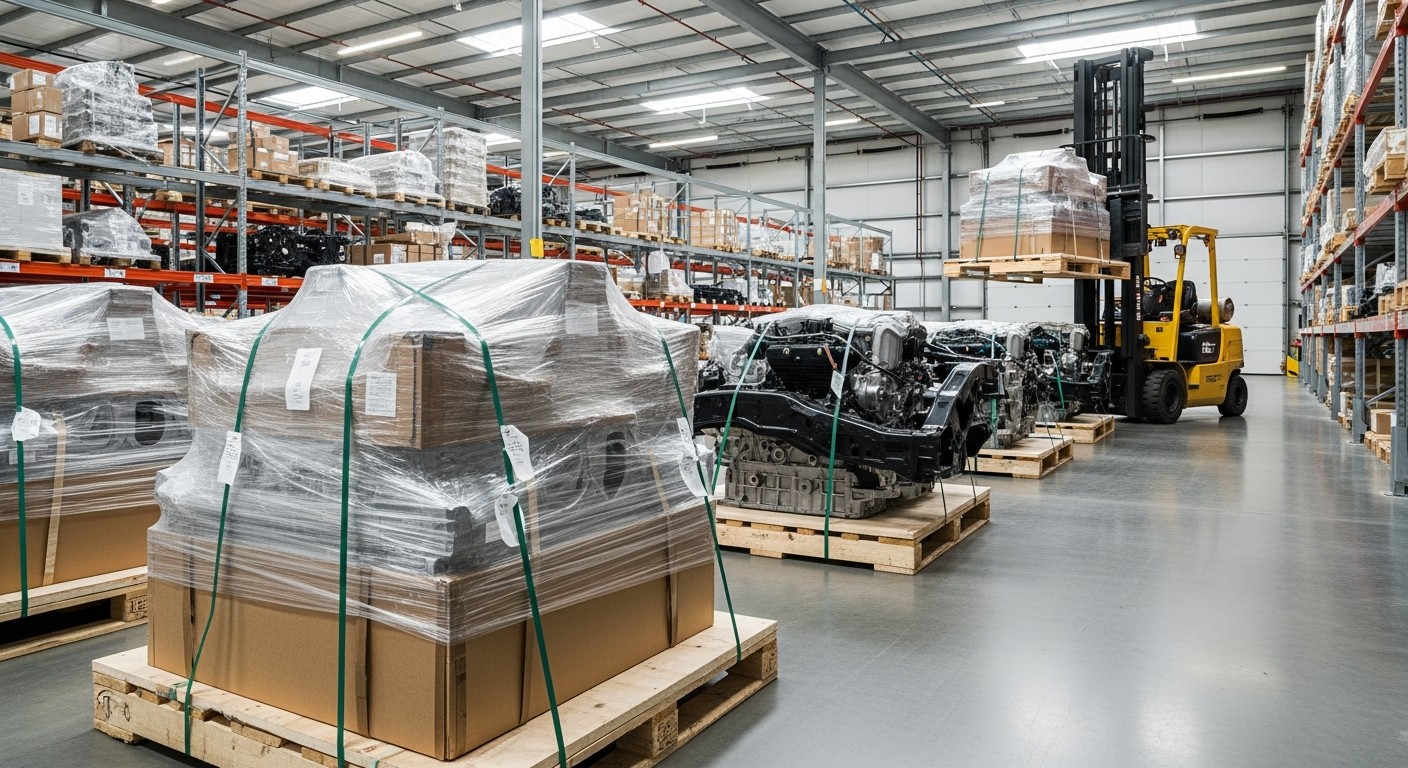
For engines, transmissions and complete subassemblies, palletised freight on a transport pallet is standard. The wrecker straps the part to a 1.2 m × 1.2 m pallet, shrink-wraps it, and books it as a one-pallet road freight movement. Door-to-door is more expensive than depot-to-depot — if you have a forklift or can collect from a depot, you'll save money.
Packing — the part of the job that costs you when it goes wrong
A panel that arrives creased, a headlight that arrives shattered or a leather seat that arrives scuffed is a refund and a wasted week for both sides. Good packing isn't optional.
Panels: foam edge protection on every edge, bubble wrap over the entire face, cardboard sleeve over that, and fragile / this-way-up labels on every face. For long panels (bumpers, sills) reinforce with timber battens to stop the box flexing.
Glass and lights: double-box. Inner box wrapped in bubble or foam, outer box with at least 50 mm of dense foam or air pillows on every side. Mark fragile clearly. Couriers do not handle anything labelled "car part" gently.
Engines and transmissions: drain all fluids first (this is also a freight regulation, not just good practice), bag and tape over openings to stop residual fluid leaking, secure to the pallet with ratchet straps, and shrink-wrap the entire pallet.
Dangerous goods: what you can and cannot ship
Australian freight carriers treat several common car parts as Dangerous Goods (DG) under the ADG Code, which means they can't be shipped on standard freight services. Lithium-ion batteries (hybrid and EV battery packs, but also some module batteries) are tightly restricted. Airbags and seatbelt pretensioners contain a small explosive charge and are class 9 dangerous goods. Fuel tanks must be drained, cleaned and certified before shipping.
Engines and transmissions are not DG provided fluids are drained. Refrigerant-charged A/C compressors are technically DG when full but most carriers accept them if drained or sold as cores.
If you're not sure, ask the carrier before you book. Sending a DG item on a non-DG service can result in the freight being seized, the sender fined, and the part written off. Several wreckers have specialist DG freight relationships and will handle airbags and battery packs for you — ask before you buy.
Insurance on freight
Standard freight cover is limited — usually $100 per consignment or a small per-kg figure, regardless of the part's value. For anything worth more than a few hundred dollars, declare a transit value and pay the additional premium (typically 1–2% of the declared value).
Photograph the part packaged before despatch, and photograph the consignment note showing the carrier's name and tracking number. If the part arrives damaged, you'll need both to substantiate a claim, and you'll need to lodge the claim within the carrier's window (usually 7 days from delivery).
Receiving the part: inspect before you sign
When the part arrives, inspect the packaging before you sign for it. If the packaging is visibly damaged — crushed corners, tears, oil leaking, pallet broken — note "damaged on arrival" on the consignment note before you sign. That note is what triggers a freight insurance claim. Signing clean and then claiming damage afterwards is an uphill battle.
Open the packaging and inspect the part within 24 hours. Photograph any damage immediately, including the packaging in the same shot, and contact the seller before you start fitting anything. On GearSwap, raise a dispute through the marketplace — the funds are still in escrow until you confirm the part is as described, so you have leverage to resolve it properly.
Saving money on freight
Some practical savings: buy from a wrecker in your state if the part is available — local pickup or regional courier is always cheaper than interstate freight. Combine multiple parts from the same seller into one consignment. If you're not in a hurry, ask for road freight rather than express — for a heavy part the difference can be 40–60%.
For very large items (full interior, bonnet plus guards plus bumper), it can be cheaper to wait for a wrecker who's already running a trailer or backload to your area than to pay full road freight per item. Reputable Australian wreckers regularly cooperate on backloads, especially on the eastern seaboard. Ask.
Returning a part
If a part needs to go back, freight is usually at the buyer's expense unless the part was misrepresented or arrived damaged in transit. Use the same packaging the part arrived in if you can — it was already engineered for that part. Get tracking, declare a transit value, and don't ship anything back until the seller has agreed to the return in writing.
On GearSwap, return logistics are coordinated through the dispute process and the funds-held escrow only releases once the part is back with the seller and inspected. That removes the worst-case scenario where you ship a part back and the seller then refuses both the return and the refund.
Cubic weight: the freight rule that surprises everyone
Australian road freight is priced on whichever is greater between actual weight and cubic weight. Cubic weight is calculated as the box's volume in cubic metres multiplied by 250 (the conversion factor most road carriers use). A 1.5 m × 0.5 m × 0.5 m bumper box has 0.375 m³ of cubic — multiplied by 250, that's a billable weight of 93.75 kg, even if the bumper itself only weighs 8 kg.
The practical lesson: pack tight. Every centimetre of empty box you ship is freight you're paying for. Carriers will not give you a discount for a half-empty box and most will round dimensions up to the nearest 5 cm.
For airfreight (rare for car parts but occasionally used for very urgent small items) the conversion factor is higher again, typically 167 kg/m³, and pricing accelerates fast.
Pickup, depot drop and door-to-door — what the labels mean
Door-to-door means the carrier collects from the sender's address and delivers to the receiver's address. It's the most convenient and the most expensive. Depot-to-depot means the sender drops at the carrier's local depot and the receiver collects from the destination depot. Cheaper, but you need a way to move the part to and from a depot — for an engine on a pallet, that's a forklift or a tilt-tray.
Pickup-to-door and door-to-depot are the two hybrids. Workshops with a forklift commonly choose depot-to-depot for inbound engines and gearboxes — the saving on a single shipment can be hundreds of dollars.
Special cases: panels, engines, glass, batteries
Panels: oversize freight, almost always road. Pack with edge protection and a rigid backer board. Add "DO NOT STACK" labels because carriers will stack anything not labelled.
Engines and gearboxes: drained, palletised, strapped, shrink-wrapped. Specify whether tail-lift delivery is required at destination — most residential addresses don't have a forklift.
Glass: double-boxed and clearly labelled. Some carriers refuse glass entirely; others charge a glass surcharge. Ask before booking.
Hybrid and EV battery packs: lithium-ion DG class. Specialist freight only — Toll Dangerous Goods, Linfox or similar. Lead-acid 12 V starter batteries are easier but most carriers still want them packaged in a leak-proof spill-tray.
Airbags and pretensioners: class 9 DG. Many carriers refuse outright. Wreckers who specialise in airbags usually have a freight relationship and can quote you a delivered price.
How freight pricing works on a marketplace
On GearSwap, freight on most listings is shown as a quote-on-request rather than a fixed shipping cost. That's because freight on used parts varies wildly with origin, destination, weight, cube and DG status — a single shipping table would either overcharge metro buyers or undercharge regional ones. Sellers send a freight quote with each parts-request response, and you see the all-in landed cost (part + freight) before you accept.
If the freight quote looks high, it's worth asking for an alternative service — depot-to-depot, road instead of express, your own freight account number — before assuming the part is unaffordable. Sellers want to ship; they'll usually accommodate a reasonable freight tweak.
Frequently asked questions
How are large car parts shipped across Australia?
Small parts go by standard courier (Australia Post, StarTrack, Couriers Please). Bulky parts like bumpers, doors and bonnets typically go by road freight on a pallet. Engines, transmissions and full subframes go palletised and strapped, usually with TNT, Northline, Mainfreight or a similar interstate freight carrier.
How long does interstate parts freight take in Australia?
Capital city to capital city is usually 2–5 business days for road freight. Regional and remote deliveries can take 7–10 business days. Express courier is faster for small parts but rarely cost-effective for anything that needs a pallet.
How much does it cost to ship a used engine or gearbox?
Palletised freight for an engine or gearbox typically runs from around $150 for short interstate runs up to $400+ for capital-to-remote-WA or NT deliveries. Cost depends on weight, pallet dimensions and destination postcode. Always get a written freight quote before you commit.
Do I need freight insurance on used car parts?
For anything fragile, expensive or hard to replace — yes. Standard carrier liability in Australia is very limited (often only a few dollars per kilogram), so an uninsured engine lost or damaged in transit is rarely fully covered. Marine transit insurance for the declared value is usually only 1–2% of the part value.
Are car batteries and airbags restricted from freight?
Yes. Lithium-ion and most lead-acid batteries, plus airbags and seatbelt pretensioners (which contain pyrotechnic charges), are classified as dangerous goods. They require dangerous-goods declarations and approved packaging, and most standard couriers will refuse them. Use a dangerous-goods-licensed freight provider for these items.
Ready to shop?
Browse 10,000+ used parts from verified Australian wreckers, or post a free parts request and have wreckers quote you direct.
Browse Parts Post a RequestJump straight to listings
Popular categories
Browse by state